
Field Dispatch: Living Through Climate Change in a Chitral's Village
A decade long onslaught of flash floods and soil erosion has driven Reshun to the brink.

On a hot August night in 2024, Qurban Ali Shah and his family members woke up to chaos and panic in his house. Shah lives in Reshun, a village in the mountainous Upper Chitral district in the north of Khyber Pakhtunkhwa. As his mind, still groggy from sleep, raced to make sense of the confusion around him, he saw his elder son rushing around the house to wake up family members, asking them to run for safety. The place was about to collapse due to rapid river erosion resulting from swelling flow of the River Chitral.
Shah and his family members scrambled out of the house getting hold of whatever possession they could on their way out as the earth crumbled under their feet. They ran to nearby piece of high land, across the Chitral-Booni Road. There they stood, Shah and his family members, watching houses, trees and the crops in the agricultural land disappearing into raging muddy torrents of River Chitral.
“We barely managed to escape with whatever on our backs,” Mr Shah told the ClimateWire Pakistan. Presently, he and his family members are lodging with his brother, who has a house in a part of the village that has thus far escaped the river’s fury.
Reshun village of Upper Chitral district is located on the eastern bank of River Chitral about 60 kilometers north of Chitral town. In the recent years, the bucolic setting of Reshun and other villages has been ravaged by the climate change related environmental degradation, flash floods and increasing land erosion. Several neighbourhoods of this village including Shader, Begalandeh, Lotdur, Raghen and Reshun Gol have borne the brunt the fierce forces of nature. Shader, where Shah and his family lives, is the hardest hit. It had 30 households before the erosion; now only 16 left.
14 of its 30 families have lost their properties, agricultural land orchards. Majority of those who have lost all their homes, properties and other possession and have nowhere to go due to meagre land holdings in mountainous areas. Those with means to sustain themselves have abandoned the village and their lost properties, moving out of the village for good, becoming climate migrants. Others, without source of income or other support have nowhere to go, stuck in the long and uncertain limbo between one climate related episode to a devastating another.
Shah said he owned two houses for each of his two wives. He also had three to four acres of agricultural land as well as cattle. Jobless, he lived off the land like many people here engaged in subsistence farming. He has nowhere left to go as he neither owns a plot of land to rebuild a house nor means to shift to a safer location..
“I do not have a job or a source of income; what I had was lost to the river,” he said. His part of the village lost five households and a Jamaat Khana – a place of worship and a community centre for people of the Ismaili faith - in August alone this year. Ten other houses were destroyed by floods over the past few years. “I am practically at my wit’s end as I have nowhere to go,” he said. “How long can one stay in someone else’s house even if it is your brother?” he said. “They have their own lives and kids to attend to. My brother is not very resourceful. It is very hard to permanently host another family with his limited means.”
At the moment though, Shah is more worried about the approaching winter when temperatures across the valley plunge below the freezing point. “A lot more resources are needed to survive the winters here,” he said.
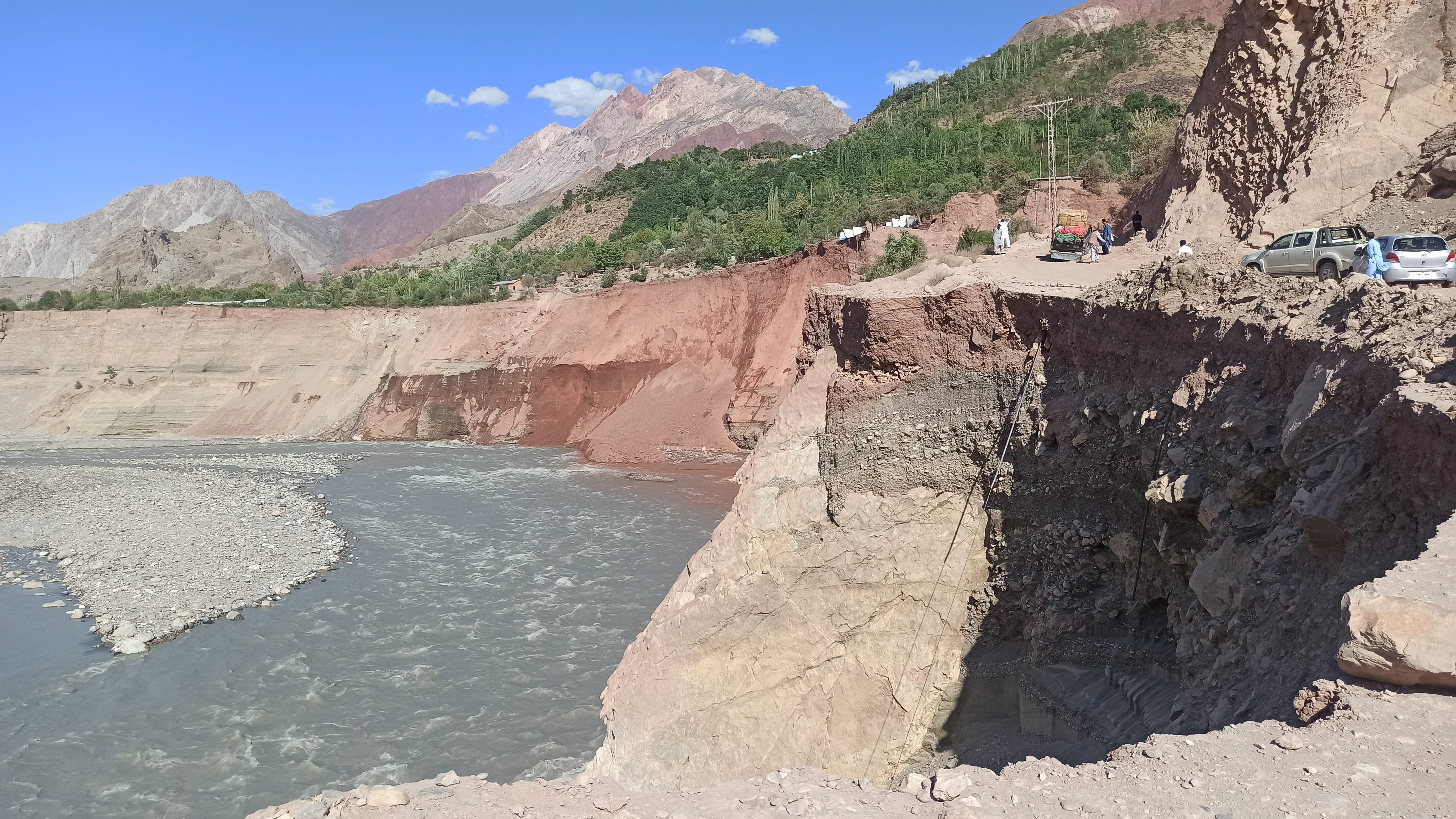
Shader is located in the shadow of a craggy cliff. The River Chitral flows over a hundred feet or so below. Until a couple of years ago, when the river changed its direction and swept the village in its course, it was a perfectly quiet neighborhood. Its calm was only disturbed by approaching vehicles that traversed the Chitral-Booni Road running through the village.
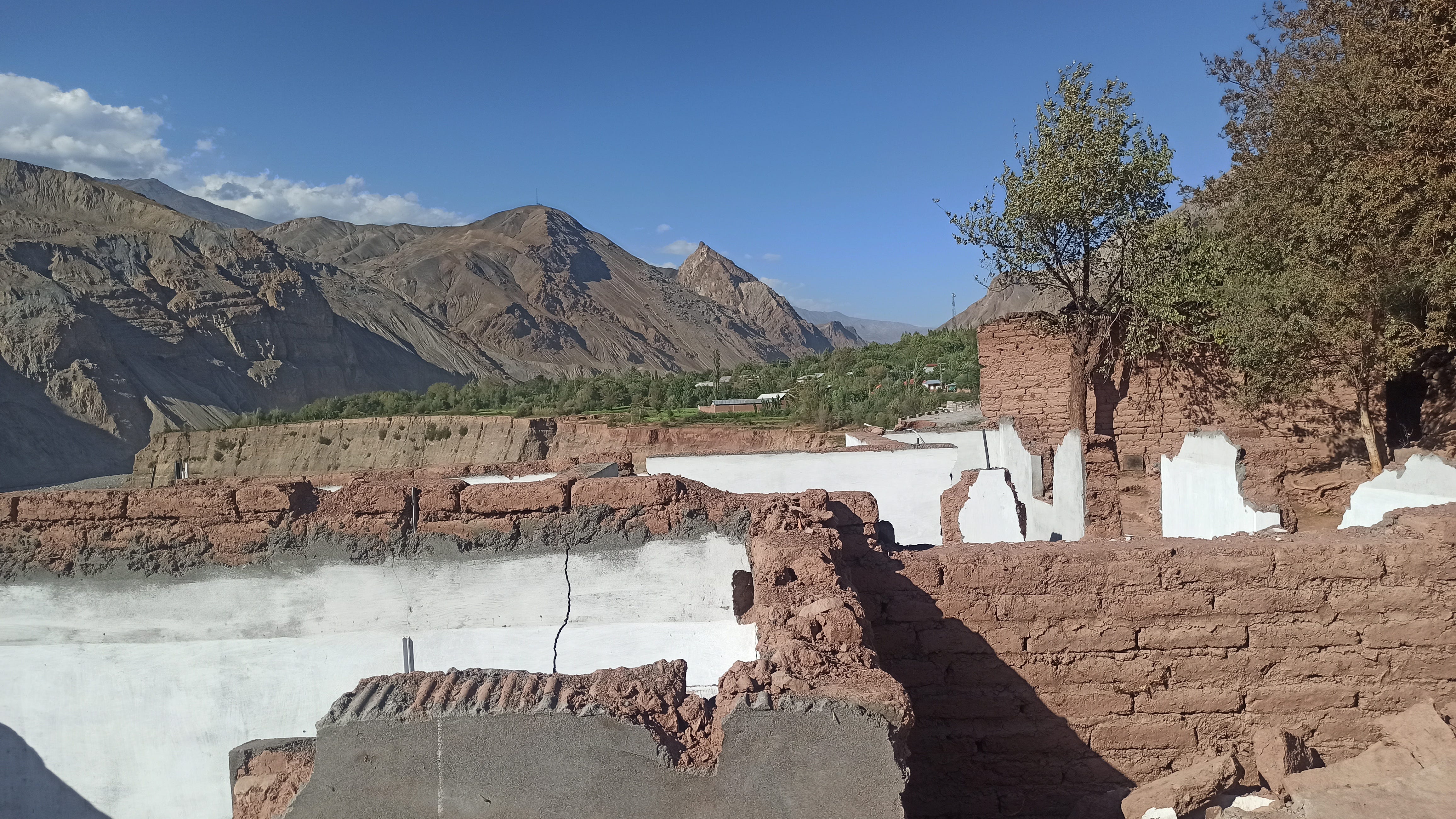
These days, a visit to this small hamlet reveals a post-apocalyptic landscape. Uprooted trees and electricity poles, piles of corrugated iron sheets and wooden beams removed from the houses destroyed, trunks of hurriedly chopped trees haphazardly piled around the narrow stretch of the road, itself on the brink of collapsing into the river. Stubs of trees that have been chopped down dot the land. Bare, broken walls of the houses without roofs and fixtures, removed by the owners, present a haunting look . A few villagers could be seen milling around on the road, anxiously waiting for the help and assistance which has yet to arrive. Next to the road, an orange color water cooler is precariously positioned on a boulder protruding out of a wall to cater to those coming to visit the area.
For the past few years, the predicament of Shader has dominated the summer news cycle in Chitral as the floods and resulting land erosion severs the road connection between Upper and Lower Chitral districts. These days, the river erosion has completely destroyed the road and only a narrow strip is left. The villagers fear that it too could collapse into the river anytime, completely severing the main road link between the two districts.
On the night of August 27, Shader area also lost its electricity supply as one of the power pylons was lost due to soil erosion. The villagers have rolled the snapped electricity wire into a mesh attached to one of the remaining electricity poles.
Stuck between apathy and agony
Sifat Ali Shah, another resident of Shader had built a house of 16 rooms for his extended family after returning from a Gulf country where he worked as labourer for more than a decade. Earlier in August last year, when the Chitral-Booni Road was destroyed due to land erosion, the disconnection of road link spurred authorities into action. They started mediating with locals to purchase land to shift the road to a safer side of the village
Sifat and seven other villagers agreed to sell their lands to the authorities to build the road, who promised to pay them Rs 13 million for the land. Sifat dissembled his house where he had meant to spend the rest of his life and shifted to a tent. The villagers allege that the authorities have only paid them Rs 3.4 million so far. The remainder of the payment is still pending. “Government has yet to pay us the remaining Rs 7.8 million,” he said, adding that it was cruel of authorities to delay their payments when they were in such a terrible situation.
He said that last year, Niaz, a resident of Shader, after losing his house to the river, left the village for good. “Since he has a government job in Drosh town of Lower Chitral, he took his family there to live in a rented house,” he said. Taj Muhammad, another villager, after losing his house and agricultural lands was given land to construct house by in his in-laws in Kosht village of Upper Chitral district.
Some other villagers were given plots to rebuild their houses by family members while others were still living in tents pitched on small plots along roadsides.
Sifat said that if the remaining thin strip of road was lost, then the rest of the 16 households of the village were also bound to lose their houses and holdings. “Since the safer portion of the village is located at an elevation over the hill compared to the road, in case of the road getting washed away there is permanent danger of the higher land sliding downward into the river,” he said.
The villagers of Shader blame the authorities’ failure to construct a proper flood protection wall alongside the river. They said that had the authorities listened to them and built a proper flood protection bund in time, none of this destruction would have happened.
Mansoor Ali Shahbab, a well-known Khowar singer, who hails from Reshun said that in a decade of recurring floods, authorities had failed to setup a proper flood protection wall to protect the village from being devoured by the river. “They practically did nothing despite us begging them,” the signer said.
He said that they even proposed to the authorities that they were ready to fund the shifting mountain debris removed during the ongoing construction of Chitral-Booni Road and dump it on the riverside to divert the course of river but no one showed any interest. “Now we are in this mess and there is no hope left,” he said.
He said that the flood protection wall the authorities built last year was so substandard that it could not last even a year. “This thing [flood related destruction of the village] is going on since 2015 but no one bothered to do anything about it,” he said. Sifat, Shah and other villagers agree with him and said that if the authorities had acted swiftly, 14 households would not have been homeless today.
Something similar is happening in nearby Begalandeh where at least three families have been left homeless when the river eroded the village lands. Raghen, another locality, is facing the same situation; however, construction of a flood protection wall has somewhat protected it this year from the river.
GLOFs and goats
The Reshun Gol area is located on both banks of a nullah of the same name. It is a picturesque area and in the past was frequented by people from other areas as a picnic spot. The main attraction was a hydel power generation station operated by the Pakhtunkhwa Energy Development Organization. In 2015, the area witnessed a massive flash flooding, which according to authorities was triggered by glacial lake outburst flood (GLOF). The flood caused widespread damages, washing away the hydel power generation station, scores of bridges, several houses, agricultural lands and orchard. Locals told the ClimateWire Pakistan that the nullah has witnessed at least five major flash flooding events since 2015. “Reshun Gol has recorded flash flooding in 2015, 2018, 2020, 2023 and 2024,” Hassan Ali a local said.
However, Mr Ali and other villagers do not buy the authorities’ argument that the flash flooding was caused due to GLOFs. They blame the renting out of summer pastures to goat-herders. Mr Ali said that the worst flood in the recent memory of the Reshun Gol was recorded in 1975 and since then there was no major flooding until the renting out of summer pastures started in 2000s. In 2013, we witnessed a major flooding and then the deluge came in 2015, he said.
Mr Ali and other villagers stated that they have taken the case of goat herders to court and won the case on several forums; however, the court’s verdict remains unimplemented.
Mr Ali and another villager Wur Gulab Khan claim that before the summer pastures were rented out, every villager used to own a few goats. Tending the entire village herd was the responsibility of a single herder. “Then there used to only a few hundreds of goats in the entire village,” they said.
Then came the goat herders. They paid money to the summer pasture owner to graze their flock there. Each of them own up to 4000 to 5000 goats in a herd. Villagers said when such a large number of animals walk the hillsides for a prolonged period of summer in dry weather, the earth is softened beneath their hooves and it tumbles down when there is a little rain. “This is what is behind the recent devastating floods in Reshun Gol,” they said.
Nizamuddin, a retired medic from the paramilitary Frontier Corps is a resident of Reshun Gol. He owns a pharmacy shop on the Chitral-Booni Road. Nizam has lost his pharmacy shop and house twice, and his five years old niece a few years ago. However, about a year ago, he decided to say farewell to his native village and settle in Chitral city. He purchased a small plot for Rs 2.6 million and spent Rs 1.6 million on construction of a grey-structure. “Living in Reshun Gol area in summer time is like nighttime vigil,” he says with chuckle. “We are on alert to rise and run even while sleeping.”
He said that living precariously was too much; it was taking its toll on their mental health. Therefore, he decided to relocate to Chitral city. “We live with great anxiety throughout the months of July, August and September,” he said.
In Green Lasht, a small town, located a few kilometers south of Reshun, authorities closed the shops located on the roadside for about a month fearing they would collapse due to the soil erosion.
Haider Ali Khan, a local said that they opened their shops on August 28 after keeping them shut for over a month. He said that they had even removed the merchandise from their shelves.
I found Baserat Bibi, 80, perched beneath a pomegranate tree in her house lawn, adjacent to Chitral-Booni Road, on the eastern bank of River Chitral. Most of the house has been dissembled and the iron sheets, wooden beams, doors and windows have been moved by the villagers to safer location.
Baserat Bibi said that she spent a month with her daughter who lives in the Gohkir village when her daughter-in-law sought refuge with her parents in Broz village as the river swelled in July. “We returned only a week ago,” she said.
She said that before the river started devouring their land holdings, they used to meet all their needs from farming. “We used to grow wheat, rice, maize, vegetables and fruits but lost all our land holdings to the river,” Baserat Bibi eyes well up.
Now, she says that they have nowhere to go. “The winter is approaching and we have only a small room. I am not sure how a family of nine persons will fit in,” she said.